What Makes a Tarot Deck Valuable?Understanding the True Worth of Your Tarot Collection
Every collector has asked it, usually while holding a deck they love: “Why is this one $15, and that one $300?”
Here's a perfect example of why the answer is never simple. Take the classic Rider-Waite-Smith Yellow Box deck. The same deck, from different print runs, can be worth noticeably different amounts — and collectors can tell them apart by the little white booklet's print run, the cardstock, even the copyright line on the cards. Same artwork, same box style, different value. That's the tarot market in a nutshell: worth lives in the details.
Whether you're thinking about downsizing or just want to understand what's sitting on your shelf, here's what actually moves the needle.
1. Print Status: In Print, Out of Print, or Limited Edition?
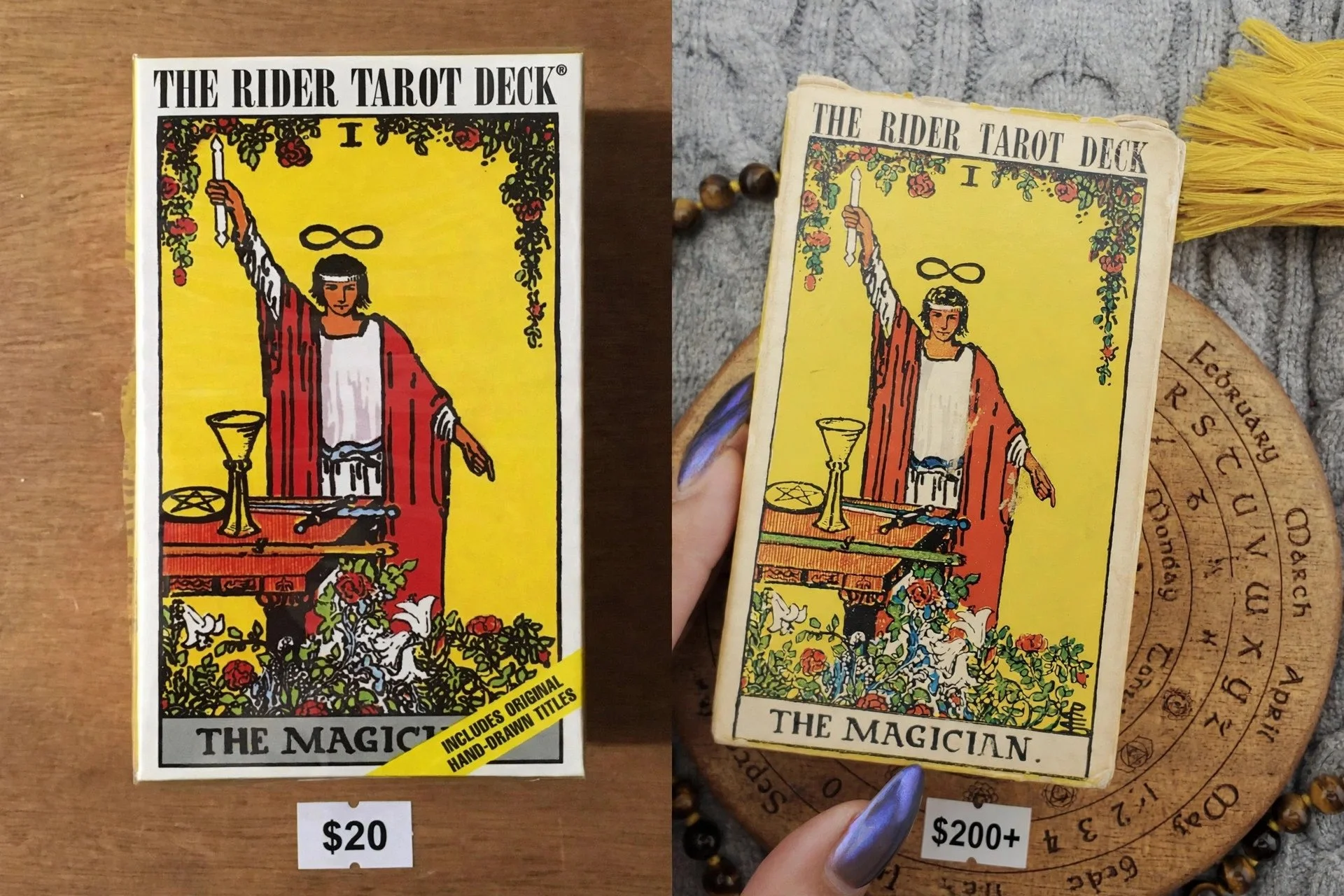
Availability is still the biggest driver of value. Out-of-print decks — especially independently produced ones — often become highly sought after. But not all OOP decks are equal. Some get reprinted every few years, while others disappear after one small run and never come back. Those are the true collector's items.
And within an edition, the printing itself can matter. Early printings sometimes differ from later ones in cardstock, coloring, or even the guidebook — small details that serious collectors notice and pay for.
Tip: a limited first edition by an indie creator, complete with its original packaging, bonus cards, or signed elements, will usually hold value better than a mass-produced reprint.
2. Artwork & Aesthetic Appeal
Beauty is subjective, but in the tarot world it moves markets. Unique illustration, hand-painted cards, and distinctive design choices drive interest — especially when the artist has a devoted following.
Collectors tend to look for:
Bold or distinctive art styles
Thematic uniqueness — mythological, botanical, gothic, and beyond
A guidebook that feels made for the cards, not bolted on
3. Indie vs. Mass Market Production
Indie decks are printed in smaller batches, often with better materials: linen cardstock, gilded edges, thoughtful packaging. That craftsmanship costs more to produce, and collectors feel the difference.
Mass-market decks are easier to find and easier to afford — which is exactly why their resale value tends to stay lower, especially once a newer edition appears.
4. Condition and Completeness
A deck in pristine condition, complete with its box, guidebook, and extras, will always fetch more than one that's missing pieces or shows heavy use.
Before you price anything, check for:
A complete card set — count them, all 78 (or more, if the deck has extra cards)
The original guidebook, especially a first-edition printing
A clean box and intact packaging
Smoke-free storage — odor sinks into cardstock and quietly knocks value off a deck
5. What Lowers a Deck's Value
Just as useful to know is what takes value away:
Missing cards — even one missing card changes a deck from collectible to incomplete
Smoke odor, which is notoriously hard to fully remove from cardstock
Sun fading, water damage, or bent and creased cards
Writing or highlighting in the guidebook
A crushed, torn, or missing box
Heavy edge wear from years of shuffling — light wear is normal, damage is not
6. Authenticity: Is It the Real Deck?
This one matters more every year. Counterfeit decks circulate widely now, and a copy that can't be verified as genuine will always be worth less than one that can. Provenance helps — where you bought it, when, and from whom — and so does knowing the tells of the real printing. When a deck's authenticity is documented, buyers pay with confidence.
7. How to Check What Your Deck Is Actually Worth
Forget Asking Prices. An Asking Price (a price posted on a site or platform) is a wish — a Sold Price is a fact. Here's how to get a real number:
Search a platform for your exact deck, including its edition and publisher.
Filter to sold listings only, and look at what copies actually changed hands for.
Compare like with like: same edition, same condition, same completeness. A sealed copy and a well-loved copy are different markets.
Ignore the outliers — one hopeful listing at triple the price doesn't set the market, and neither does one bargain.
Check more than one sale if you can. A pattern of similar prices is the truth; a single sale is a hint.
One warning: if a deck you own gets reprinted, expect its value to drop. That's the moment a lot of "rare" decks quietly become common again.
8. Energetic and Emotional Value
This won't show up in a sold listing, but it counts — and it makes a fine keeper test. Some decks carry a resonance that makes them priceless to their owner, whatever the market says. If the thought of selling a deck makes you wince, that's your answer: it's a keeper, no matter what the sold listings say.
Final Thoughts
Understanding what makes a deck valuable helps you make better decisions about buying, selling, or simply appreciating what you already own. Worth isn't only rarity or price. It's connection, intention, and care.
And if you're curious what your own collection might be worth — or you're starting to think about its next chapter — we'd love to look at it with you.
https://www.avtarotreading.com/sell-to-us
That's what we do: help collections move on to people who'll treasure them, with their stories intact.
Frequently Asked Questions
Are out-of-print tarot decks always valuable?
No — out of print is only half the equation. A deck needs to be both scarce and sought after. Plenty of OOP decks sit quietly at their original price because nobody's looking for them.
Do used tarot decks lose value?
Light, honest wear from reading is expected and doesn't hurt much. What hurts is damage: missing cards, smoke, water, and broken packaging. A complete, well-cared-for used deck still holds its value well.
Are fake or counterfeit decks worth anything?
Very little to collectors, and they should never be sold as genuine. If you're unsure about a deck, verify it before you buy.
Should I sell my deck or keep it?
Run the keeper test: if you'd regret it, keep it. If you're ready to pass it on, count the cards, check the condition, and look up sold listings first — you'll walk into the sale knowing exactly what you have.